
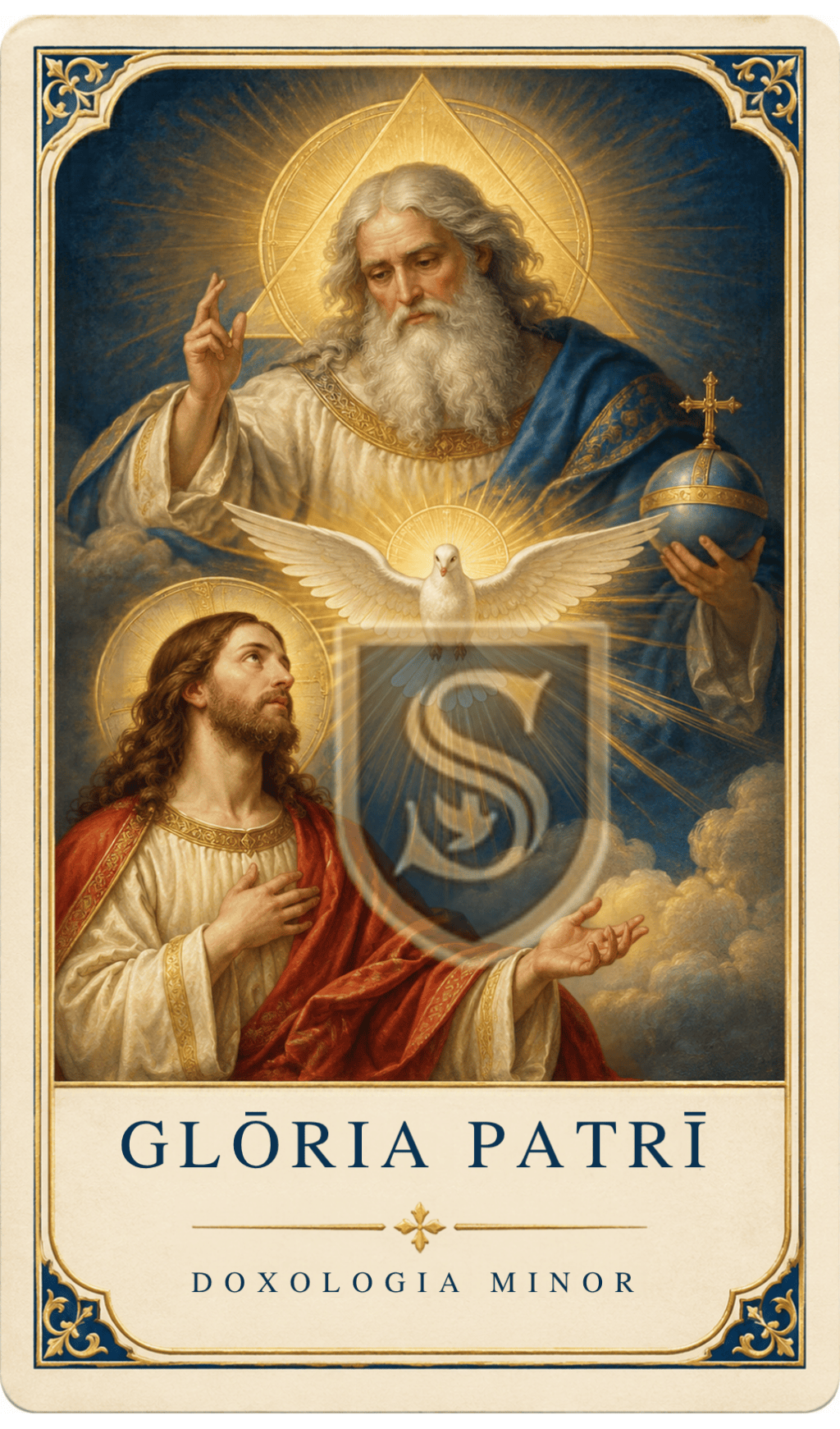
The Glōria Patrī, commonly known as the Glory Be, is one of the fundamental prayers of Catholic devotion. Its concise text offers an excellent opportunity to study Ecclesiastical Latin through vocabulary, grammatical forms, and sentence structure.
Although the prayer is brief, it contains several useful features for students of Latin, including the dative case, adjective agreement, the imperfect tense, and different uses of the preposition in.
The Latin Text
Glōria Patrī,
et Fīliō,
et Spīrituī Sānctō.
Sīcut erat in prīncipiō,
et nunc, et semper,
et in saecula saeculōrum.
Āmēn.
What Can the Prayer Teach Us?
1. The Dative Case
The opening words contain three dative nouns: Patrī, Fīliō, and Spīrituī. These forms express the recipients of glory and correspond to “to the Father,” “to the Son,” and “to the Holy Spirit.”
Students can see how grammatical case communicates relationships between words, even when the Latin sentence is more compact than its English translation.
2. Adjective Agreement
In Spīrituī Sānctō, the adjective Sānctō agrees with Spīrituī in gender, number, and case. Both words are masculine dative singular.
This provides a practical example of how Latin adjectives change their forms to agree with the nouns they describe.
3. The Verb Erat
The word erat is the third-person singular imperfect indicative of sum, esse, fuī, futūrus—the verb “to be.” It means “was” and appears in the phrase Sīcut erat in prīncipiō, “As it was in the beginning.”
Recognizing this form helps students connect familiar prayers with the broader system of Latin verb conjugation.
4. In Saecula Saeculōrum
The closing phrase illustrates another important grammatical distinction. In in prīncipiō, the preposition in takes the ablative to express location or time. In in saecula saeculōrum, it takes the accusative to express extent or duration.
The expression is traditionally translated “world without end” or “unto the ages of ages.”
Study the Prayer in Greater Depth
The Glōria Patrī Study Guide from Schola Sacrae develops these observations into a guided learning resource. It includes vocabulary explanations, grammatical analysis, phrase-by-phrase commentary, parsing exercises, and an answer key.
The guide is intended for students who wish to move beyond memorizing a prayer and begin understanding its Latin structure.
Through the study of familiar Catholic prayers, Ecclesiastical Latin becomes a language that can be examined, understood, and read with greater confidence.
Explore Schola Sacrae’s Ecclesiastical Latin resources to continue studying the language of Catholic prayer and sacred texts.
Click here to purchase the study guide.


Leave a Reply