Learning to read Ecclesiastical Latin requires more than memorizing vocabulary. Understanding how verbs function is essential to interpreting prayers, liturgical texts, and other works of the Catholic tradition.
Among the most important verbs to study are sum (“to be”) and several other irregular verbs whose forms do not always follow the patterns of regular conjugations. These verbs appear throughout Latin literature and sacred texts, making familiarity with their forms an important part of developing a strong grammatical foundation.
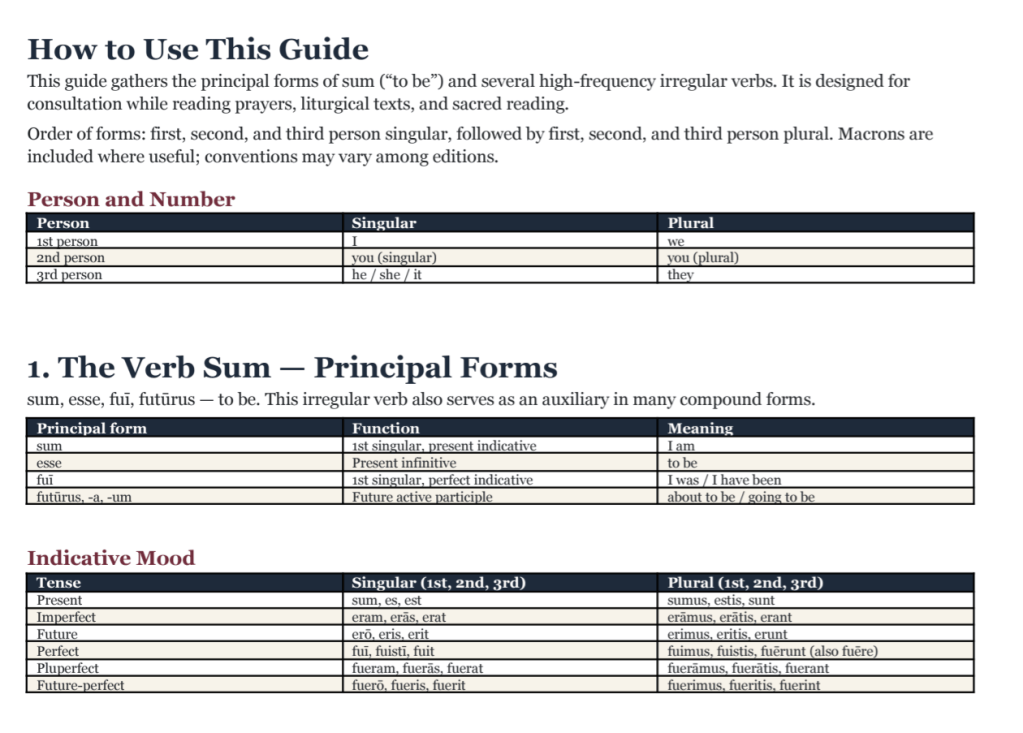
The Sum and Irregular Verbs Reference Guide
Schola Sacrae has developed the Sum and Irregular Verbs Reference Guide, a PDF printable resource designed to support the study of Ecclesiastical Latin.
The guide brings together reference material for several important verbs, including:
- Sum, esse — to be
- Possum, posse — to be able
- Eō, īre — to go
- Ferō, ferre — to carry or bear
- Volō, nōlō, and mālō — to wish, to be unwilling, and to prefer
- Fīō, fierī — to become and its role in passive constructions
The guide also covers compounds of sum and includes grammatical explanations, summary tables, and a practical parsing checklist.
A Resource for Independent Study
Whether reviewing verb forms, working through a Latin grammar lesson, or developing the skills needed to read Catholic prayers in their original language, a well-organized reference can make regular study more efficient.
The guide is designed for use alongside textbooks, structured courses, and independent Latin study.
Product details
- Digital PDF Irregular Verb Guide
- US Letter format (8.5 × 11 inches)
- Suitable for printing at home or through a print shop
- Instant digital download
The Sum and Irregular Verbs Reference Guide is available through the Schola Sacrae online shop.
Continue building a foundation in Ecclesiastical Latin with Schola Sacrae.
Schola Sacrae — Resources for the study of Ecclesiastical Latin and Catholic sacred texts.


Leave a Reply